

Current sensor accuracy cannot be judged from a single percentage printed on a specification sheet. The more useful comparison considers accuracy together with linearity, offset, temperature drift, bandwidth, noise, measuring range, and the conditions under which each figure was obtained.
That distinction matters in any Fluxgate Current Sensors comparison because two devices can show similar headline accuracy while behaving quite differently at low current, across temperature changes, or during rapid transients. Hangzhi and LEM both use closed-loop fluxgate principles in high-precision current measurement, but their published product specifications span different current ranges, packaging approaches, and performance targets.
Accuracy Means More Than One Percentage
A useful starting point in Hangzhi vs LEM comparisons is the definition behind the accuracy figure. Some specifications express total error as a percentage of nominal current, while other technologies or documents may reference the measured value under particular conditions. LEM’s high-precision portfolio, for instance, lists overall accuracy alongside nominal current, bandwidth, mounting method, and technology, allowing the specification to be interpreted within a defined application context.
Linearity should then be considered separately. It describes how closely the sensor’s output follows the expected relationship across the measuring range. A device can have a strong overall accuracy figure but exhibit a different linearity profile from another device. Hangzhi’s AIT Series is specified with 2 ppm linearity, while the IIT Series offers 0.02% accuracy across a 1–10,000 A range, demonstrating why accuracy and linearity should not be treated as interchangeable measurements.
Offset becomes particularly significant at low current. Even a small zero-current error can represent a meaningful portion of the actual signal when the measured current is far below the sensor’s nominal rating. Fluxgate Current Sensors gain an advantage in this area because the zero-flux operating principle can provide low offset and low offset drift, which is one reason the technology is used in precision measurement applications.
How Offset, Drift, and Temperature Change Fluxgate Current Sensors Performance
Temperature can alter several parameters simultaneously, so a specification measured only at room temperature may not describe real operating behavior. Offset drift, gain variation, linearity, and noise should be checked across the stated temperature range rather than viewed as isolated laboratory values.
Hangzhi’s AIT Series specifies 2 ppm linearity, 0.2 ppm per month time stability, and a temperature impact of 0.1 ppm per degree across an extended operating temperature range. The IIT Series provides 0.02% accuracy with measurement ranges extending to 30 kA.
The About Hangzhi page is also relevant when evaluating the engineering background behind the numbers. Hangzhi describes multi-point zero-flux technology, closed-loop control, and high-frequency ripple measurement within its current-measurement architecture. Such technical details help explain why offset, drift, and dynamic behavior appear together in high-precision sensor specifications rather than functioning as independent selling points. Any Hangzhi vs. LEM comparison of current sensor measurement accuracy should evaluate offset, drift, and temperature behavior alongside the headline accuracy figure.
Bandwidth and Range Reveal Application Fit
Accuracy does not automatically describe dynamic performance. A sensor intended for DC monitoring may have entirely different bandwidth requirements from one measuring inverter switching behavior, motor transients, or high-frequency ripple. The frequency range should be considered alongside response time, signal amplitude, and the type of waveform being measured.
Hangzhi’s published specifications illustrate the variation available within one portfolio. The AIT Series provides bandwidth options of 800 kHz or 500 kHz, while the IIT Series reaches 100 kHz with measurement ranges extending to 30 kA. The DIT Series specifies 0.02% accuracy with digital output across a 60–2,000 A range.
A practical Hangzhi vs LEM evaluation also needs to consider the intended current range rather than comparing bandwidth figures in isolation. A sensor designed for a high-current bus and another intended for PCB-level measurement may serve completely different purposes even if their headline accuracy appears similar. Range, conductor arrangement, installation space, isolation, and output format can ultimately matter as much as the precision number.
Hangzhi vs LEM: Product Architecture and Real-World Selection
Split-core construction introduces another dimension that conventional accuracy comparisons may overlook. Opening the magnetic core can simplify installation around an existing conductor, but mechanical convenience can be accompanied by different performance characteristics compared with solid-core designs. LEM’s technical documentation specifically notes that split-core implementations can have reduced specifications relative to solid-core versions.
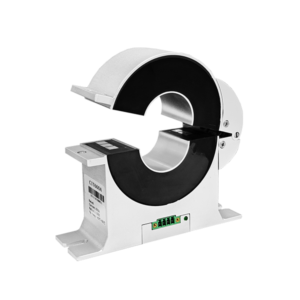
For a concrete high-current example, Hangzhi’s High Precision Split Core Current Transducer-CIT Series covers 100–1500 A, with 0.05% accuracy and 350 kHz bandwidth. Those specifications position the device around applications that need relatively high current capacity, split-core installation, and meaningful frequency response without requiring the ppm-level performance associated with specialized metrology equipment. The model should be assessed according to the actual operating current and installation constraints rather than compared only through its accuracy percentage.
Another important distinction concerns output and integration. Current-output transducers may suit existing acquisition hardware, while voltage or digital interfaces can be more appropriate for other control architectures. Hangzhi’s high-precision portfolio includes current-output and voltage-output devices across several mounting configurations, while the DIT Series targets digital integration with RS232/RS485 output and the CAFR Series addresses PCB-level measurement.
Conclusion
Specification comparison becomes much clearer once accuracy is treated as a system of related parameters rather than a single headline value. Offset determines how small signals are represented near zero, linearity describes behavior across the measuring range, temperature characteristics reveal stability under changing conditions, while bandwidth and response time show how faithfully dynamic currents can be captured. These factors give Fluxgate Current Sensors their practical measurement profile.
The strongest selection method is consequently application-based: define the current window, identify the dominant error sources, establish the required dynamic range, then compare equivalent specifications under matching conditions. Hangzhi provides models spanning different current levels and mechanical formats, with published specifications covering 1 A to 30 kA, 10 ppm accuracy, 2 ppm linearity, and bandwidth options up to 800 kHz. For technical teams that need more application-specific information, the manufacturer resources can be reviewed or further details can be requested through contact us.
