

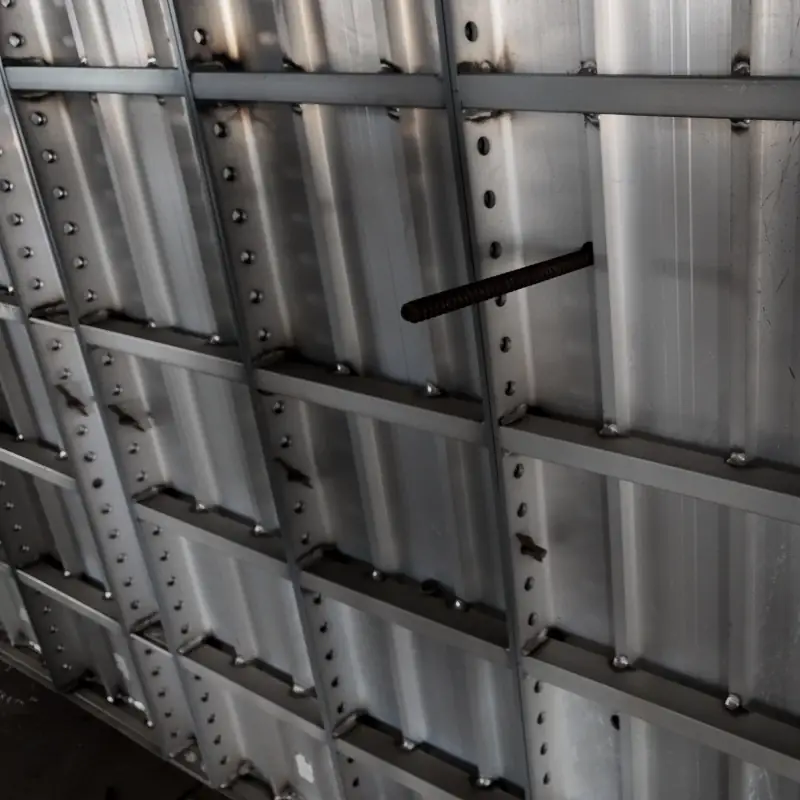
Modern high-density residential development relies heavily on standardized floor layouts to maximize spatial efficiency and control total construction expenditures. Managing tight turnarounds for multi-story housing schemes necessitates temporary forming equipment that balances high structural accuracy with rapid manual repositioning. Deploying lightweight aluminum concrete formwork allows construction managers to establish predictable, streamlined floor-to-floor pouring cycles without relying constantly on heavy tower cranes.
Project directors evaluating forming solutions for large-scale residential initiatives frequently specify precision-engineered modular systems from manufacturers like Rongze to maintain tight dimensional tolerances and control site labor budgets across every phase of construction.
Architectural Standardization and Cycle Optimization
High-Rise Residential Buildings and Apartment Complexes feature highly repetitive structural designs that repeat floor after floor. Utilizing standardized panel configurations enables construction teams to transition forming equipment from one level to the next with minimal layout modifications. This structural repetition optimizes labor productivity, as workers become highly proficient in the specific panel assembly sequence required for each typical floor.
Streamlining formwork handling yields predictable four-to-five-day floor cycles, directly accelerating overall project delivery schedules. Fast turnaround times prove especially critical in Affordable Housing Projects, where controlling field overhead costs determines overall financial viability. Standardized panel geometry reduces material handling delays, enabling site managers to maintain aggressive structural schedules across sprawling multi-building developments.
Structural Versatility Across Monolithic Pours
Monolithic concrete casting allows vertical walls, columns, beams, slabs, staircases, and elevator shafts to be poured simultaneously in a single continuous operation. Executing monolithic pours requires an integrated forming setup capable of supporting complex intersections without leaking liquid mortar during vibration. Advanced modular panel assemblies tie wall and deck components together seamlessly, creating a rigid, leak-tight containment shell for fresh concrete.
Integrating functional elements like Staircases and Elevator Shafts directly into primary wall pours improves total structural rigidity while reducing secondary masonry work. The Aluminum Formwork System is widely used in various concrete construction projects, providing the geometric precision necessary to align vertical core walls with horizontal floor slabs accurately. Synchronizing structural pours simplifies site logistics and produces a monolithic concrete structure that meets stringent engineering specifications.
Surface Finishing and Finishing Trade Efficiencies
Superior dimensional accuracy and tight joint fitting prevent cement slurry leakage during concrete placement, yielding smooth, fair-faced concrete surfaces. Traditional timber or plywood setups frequently leave joint ridges, bowing surfaces, or porous aggregate pockets that require expensive post-pour grinding and plastering. Extruded aluminum alloy panels maintain flat contact surfaces under fluid concrete pressure, preserving nominal wall thicknesses across repetitive pours.
Delivering fair-faced concrete finishes allows finishing trades to apply skim coat plaster or direct paint finishes without thick underlying mortar beds. Minimizing plastering material demands lowers overall finish costs while reducing structural dead load on elevated slabs. Smooth wall surfaces prove particularly advantageous across Commercial Buildings, Hotels, Hospitals, Schools, and Office Buildings, where high architectural finish standards must be achieved efficiently.
Manual Handling Efficiency and Crane Independence
Weight constraints strongly influence site equipment selection, particularly on urban jobsites where tower crane availability is severely restricted. Heavy steel forming panels require crane support for every lifting step, creating logistical bottlenecks when multiple site trades compete for crane time. Precision-extruded aluminum panels offer exceptionally high strength-to-weight ratios, enabling workers to manually transport and position individual panels without heavy machinery.
Manual pin-and-wedge connection mechanics allow small crews to dismantle, move, and reassemble wall and deck panels rapidly through interior floor openings. Eliminating crane dependence for vertical formwork movement frees up hoisting equipment to handle rebar bundles, MEP materials, and precast components simultaneously. Improved site logistical flexibility accelerates daily work routines, enabling contractors to complete projects faster with lower equipment rental costs.
Material Durability and Asset Reuse Lifecycle
Evaluating capital investments in temporary forming systems requires assessing the long-term cost per pour cycle over extended operational lifecycles. Traditional wood formwork degrades rapidly after five to ten uses due to moisture absorption, edge splitting, and surface wear, leading to high material waste. Premium aluminum alloy panels withstand aggressive mechanical handling and chemical concrete exposure, offering hundreds of reuse cycles with minimal surface maintenance.
Durable extruded aluminum frames resist deformation during stripping and transit, preserving dimensional accuracy over multi-year deployment lifecycles. High panel durability reduces long-term material replacement expenses, making the system an ideal choice for projects with standardized floor layouts and repetitive structural designs, where fast construction and cost control are essential. Sustainable material reuse lowers total jobsite waste, supporting environmentally responsible construction practices on large-scale builds.
Corrosion Defense and Environmental Resilience
Exposing jobsite equipment to rain, atmospheric humidity, and alkaline concrete slurry creates ongoing oxidation risks for metal inventory. Unprotected carbon steel frameworks form surface rust that eventually erodes structural wall thickness and stains finished concrete faces. Aluminum alloy naturally forms a tough, self-healing oxide layer upon exposure to air, providing inherent protection against environmental corrosion without requiring thick applied coatings.
Superior corrosion resistance prevents rust binding around connection keyholes and alignment slots, maintaining smooth panel fitment through hundreds of pour sequences. Shielding equipment against corrosion preserves lightweight handling properties and neat appearance, protecting long-term capital investments for contractors and rental fleets. High atmospheric resilience allows aluminum panels to perform reliably across coastal, humid, and challenging climate conditions worldwide.
Key Operational Value Summary
In the context of repetitive residential projects, operational efficiency and cost-effectiveness are largely determined by forming systems that enable swift handling and prolonged reuse. An engineered aluminum formwork system delivers the necessary structural integrity, ergonomic maneuverability, and exacting dimensional tolerances required for monolithic concrete placement in high-rise buildings.
Its superior surface finish eliminates the need for costly subsequent plastering, while its crane‑free assembly logic accelerates floor‑to‑floor construction cycles. By sourcing verified modular formwork from experienced partners such as Rongze, project managers secure reliable structural performance, enhanced workforce productivity, and enduring asset value across complex international developments.
