

A successful lighting upgrade is not simply a matter of replacing old lamps with LEDs. For factories, warehouses, retail facilities, and other commercial sites, a refurbishment project must balance existing infrastructure, visual performance, installation disruption, controls, and lifecycle cost. Careful planning can determine whether an upgrade delivers measurable operational value or creates new compatibility and maintenance problems. The following steps provide a practical framework for evaluating an LED refurbishment project from initial assessment through final commissioning.
- Audit the Existing Lighting System
The first step is to document the existing installation. Facility teams should record luminaire types, quantities, wattage, mounting positions, circuit arrangements, operating hours, control methods, and visible maintenance issues. The condition of existing trunking, wiring, drivers, and connection points should also be checked before deciding whether components can be retained.
This assessment establishes the technical baseline for lighting refurbishment. It also helps project teams identify areas that are over-lighted, under-lighted, difficult to access, or unnecessarily expensive to operate. DOE guidance similarly notes that retrofit decisions should consider existing luminaire condition, desired photometric performance, accessibility, budget, and ongoing economic objectives.
- Define Lighting and Operational Requirements
A replacement system should be designed around the activities performed in each space rather than around the specifications of the old installation. Production areas, storage aisles, inspection stations, offices, and retail floors can have different visual requirements. Illuminance, uniformity, glare, color rendering, and light distribution should therefore be established before products are selected.
Project teams should also consider operating schedules and future layout changes. A facility that expects production lines or shelving to move may benefit from modular lighting and adjustable controls. Defining these requirements early makes the LED refurbishment more measurable. The proposed system can then be evaluated against specific operational objectives rather than simply against lamp wattage.
- Check Infrastructure for LED Refurbishment Compatibility
Compatibility is one of the most important practical issues in retrofit work. Reusing existing trunking or electrical infrastructure can reduce structural work, but only when the new equipment is genuinely compatible with the installed system. Buyers should verify rail type, power pick-up positions, electrical connections, dimensions, mounting arrangements, and any limitations imposed by the existing circuit.
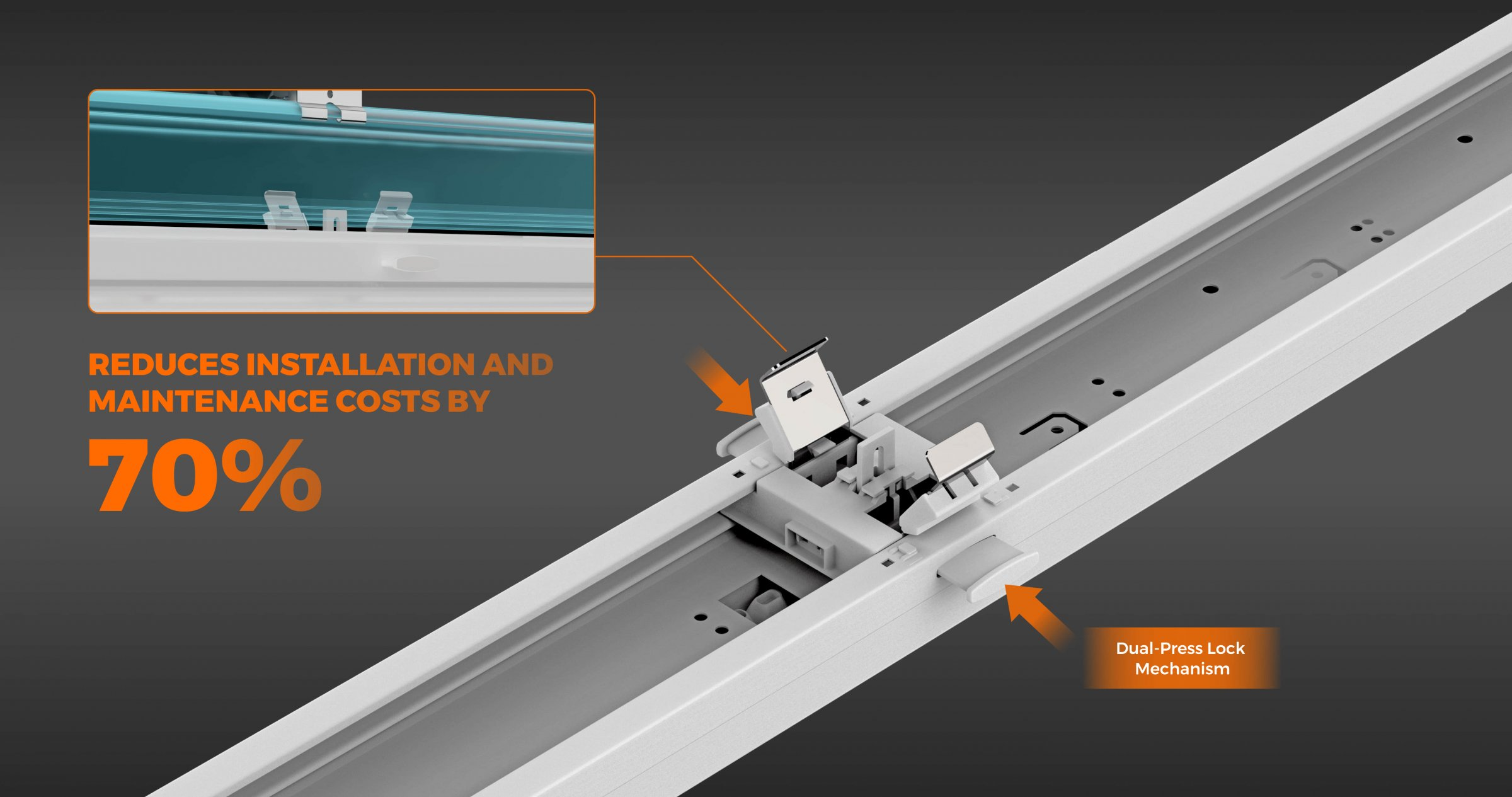
TRIECO’s DREAMFIT is designed specifically for LED trunking retrofit and system renewal where the existing trunking circuit can be reused. Its power pick-up flying plugs are compatible with more than 30 types of mainstream European trunking rails, and the plugs fit up to 90% of power pick-up points on the market. The system is designed for plug-in connection without structural modifications, trunking replacement, or rewiring.
- Evaluate Optical Performance, Not Just Efficiency
High efficacy can reduce electrical consumption, but it does not guarantee a better working environment. Buyers should examine luminous flux, distribution, uniformity, color rendering, and glare together. DOE guidance warns that different LED distributions can increase glare or produce uneven light levels, making calculations or mock-up measurements useful before a large installation.
TRIECO’s DREAMFIT specifies 180 lm/W luminous efficacy and up to 13,500 lm luminous flux. It also specifies CRI>80 and UGR<16. These characteristics can be relevant where accurate color perception and controlled glare matter. The exact configuration, spacing, mounting height, and optical distribution should still be validated through project-specific lighting calculations.
- Plan Controls and Future Flexibility
A modern refurbishment can go beyond fixture replacement by considering dimming, occupancy sensing, scheduling, and energy monitoring. Controls should be selected according to how the facility operates. Areas with variable occupancy may benefit from automatic control, while continuously occupied production zones may require a different strategy.
DREAMFIT supports options including DALI digital dimming, 1-10V analog dimming, smart sensing, occupancy sensing, human-presence detection, and IoT integration. Its luminaires can also use DIP switches to select seven power levels from 30W to 74W. Such flexibility can help project teams adjust output to actual requirements instead of locking every area into one fixed power setting.
- Manage Installation, Testing, and Commissioning
Even a technically suitable product can underperform if installation is poorly managed. A refurbishment plan should define work zones, isolation procedures, access requirements, temporary lighting, installation sequencing, and acceptance criteria. For operating facilities, phased installation can help limit disruption to production or customer-facing activities.
After installation, commissioning should confirm illumination levels, controls, emergency functions where applicable, and system operation. A final inspection should compare actual performance with the approved design. DOE guidance also emphasizes commissioning and recommissioning as part of maintaining lighting performance as buildings and systems change.
- Measure Results After the Upgrade
The final stage is to verify whether the project achieved its intended outcomes. Energy use, maintenance frequency, lighting quality, control performance, and user feedback can provide useful indicators. Comparing these results with the original baseline gives facility managers evidence for future capital planning.
A well-managed lighting refurbishment therefore extends beyond product selection. It starts with an accurate site assessment, establishes measurable requirements, confirms infrastructure compatibility, evaluates optical quality, and plans installation and commissioning carefully. TRIECO‘s DREAMFIT demonstrates how an LED refurbishment strategy can reuse compatible trunking infrastructure while adding modular LED performance and control options. For businesses, this structured approach can make the investment easier to evaluate and manage over its operating life.
