

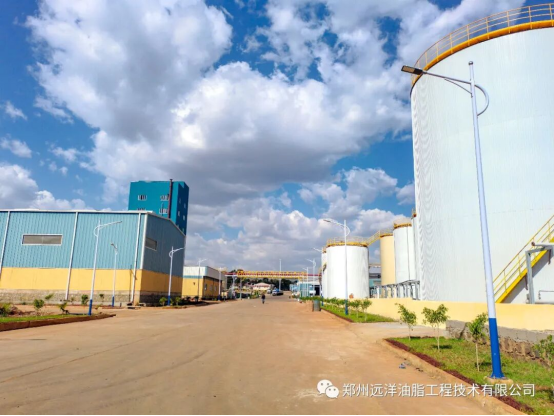
In the Horn of Africa, an integrated oils and fats processing complex built by a Chinese company has become the largest, most technologically advanced, and most comprehensive oils and fats refining and fractionation facility on the African continent. This achievement represents not just the successful delivery of an engineering project, but a landmark moment for Chinese oils and fats equipment technology in establishing its reputation across Africa.
Project Overview: A Scale Beyond Convention
This project, undertaken by Ocean for Phibela Industrial Plc, is unprecedented in scale for Africa. The core facilities include a 600-ton-per-day vegetable oil (including crude palm oil) refining line and an 800-ton-per-day RBD palm oil fractionation line, along with technical services, engineering drawings, and consulting for auxiliary facilities supporting a 600-ton-per-day vegetable oil refining and fractionation complex.
Yet this is only part of the story. Beyond the standard refining and fractionation capacity, the project specifically incorporates production capabilities for margarine, shortening, and specialty fats, achieving full-chain coverage from basic oil processing to finished food ingredients. This level of integration is exceptionally rare among existing oils and fats facilities in Africa, making it the continent’s undisputed “largest, most advanced, and most comprehensive refining and fractionation plant and edible oil factory.”
The Challenge: Achieving Precision Control on the “Roof of Africa”
Ethiopia averages nearly 3,000 meters above sea level, earning it the nickname “Roof of Africa,” with annual temperatures ranging from 9.7°C to 25.5°C. Rainfall varies significantly by season and region, and local droughts are common.
Such geographical conditions impose specific requirements on oils and fats refining and fractionation processes. Whether designing the vacuum system for refining or controlling crystallization temperatures in fractionation, every parameter must be recalibrated to account for local average ambient temperature, relative humidity, and atmospheric pressure. Ocean dispatched technical personnel for on-site surveys and adjusted the basic equipment parameters to accommodate these external factors, ensuring that oil quality consistently meets the highest standards under Ethiopia’s unique natural conditions.
Another practical consideration in the project design was the convenience of local operation. Given the limited availability of skilled labour at the project site, Ocean implemented a fully computerized automatic control system that manages everything from electrical equipment monitoring to process parameter regulation. This design not only ensures production stability and consistency but also substantially reduces the technical skill requirements for on-site operators.
Technology Integration: A Comprehensive Solution Powered by Nine Core Technologies
Ocean applied its proven nine core technologies in this project, including low-temperature, long-mix continuous alkali refining; physical refining; anhydrous soap removal; cryogenic vacuum deodorization; odour removal from decolorization filter cake-blowing steam; pre-stripping and post-stripping in deodorization; intelligent combined soft-tower design; full waste-heat recovery; and intelligent automation control.
The integrated application of these technologies delivers tangible results across multiple dimensions. In the refining stage, the system can flexibly switch between physical and chemical refining routes depending on crude oil quality, ensuring efficient deacidification while maximizing the retention of nutrients like vitamin E. In the fractionation stage, the 800-ton-per-day palm oil fractionation line, through precise control of crystallization rate, temperature, and conditioning time, can produce palm oil products with different melting points — 8°C, 10°C, 14°C, 18°C, 24°C, 33°C, 44°C, and 55°C — meeting the diverse requirements of the food industry for different hardness and melting profiles.
Beyond Refining: The Extended Value of Full-Spectrum Oil Products
What sets this project apart is the completeness of its product chain. In addition to refining and fractionation, Ocean helped the client establish production capacity for margarine, shortening, and specialty fats. This means the project is not merely a crude oil processing base but a fully integrated plant capable of producing finished consumer products directly.
This configuration has profound implications for Ethiopia. For a long time, the country’s weak industrial base has meant that edible oils and related food ingredients have been heavily dependent on imports. The completion of this project not only ensures the local supply of edible oils for the population but also provides locally sourced oil-based raw materials for downstream industries such as food processing, light manufacturing, pharmaceuticals, and chemicals, filling a significant gap in specialty oil products in northern Africa.
Conclusion
From a technical perspective, Ocean’s 600/800TPD integrated oils and fats project in Ethiopia represents the systematic integration of nine core technologies, addressed the challenge of limited local human resources through a fully automatic control system, and from an industrial perspective, extended the value chain from simple oil refining to finished food ingredient production, creating a complete oils and fats processing industry chain for the region.
From a broader viewpoint, the significance of this project extends far beyond the engineering itself. It demonstrates that Chinese oils and fats equipment technology is fully capable of delivering world-class integrated solutions in complex overseas environments. As the project practice has shown, technology can transcend national boundaries, service can be delivered with zero distance, and quality is the common language that wins markets.
