

Reliable backup power has become an important consideration for businesses managing operational continuity, temporary projects, and emergency situations. However, choosing the right generator requires more than comparing output capacity. Companies need to evaluate fuel availability, installation requirements, mobility, power quality, and long-term operating conditions. When comparing a portable generator with inverter and a natural gas generator, understanding their differences can help businesses select equipment that matches their specific applications.
Different industries have different power demands. Construction companies may require mobile power solutions across multiple locations, while commercial facilities may need fixed backup systems during utility failures. By considering how and where the generator will be used, businesses can make a more practical investment decision instead of focusing only on individual specifications.
Understanding the Benefits of a Portable Generator with Inverter
A portable generator with inverter is designed to provide stable and cleaner electricity through inverter technology. Compared with traditional generator systems, inverter models can better regulate power output, making them suitable for equipment that requires consistent voltage and frequency.
This advantage is particularly valuable for businesses operating sensitive electronic devices, such as computers, communication systems, monitoring equipment, and other technology-based tools. Stable power quality can help reduce the risk of interruptions or potential damage caused by inconsistent electrical output.
Portability is another important advantage. A portable inverter generator can be transported between job sites, outdoor events, temporary facilities, and emergency locations. For businesses with changing power requirements, this flexibility allows one generator to support multiple applications instead of being limited to a single installation site.
Evaluating the Role of a Natural Gas Generator
A natural gas generator is commonly used as a stationary backup power solution for facilities that require reliable long-term operation. These systems are often connected to an existing natural gas supply, reducing the need for on-site fuel storage and manual refueling.
For businesses such as commercial buildings, industrial facilities, and critical service providers, natural gas generators can offer convenience during extended outages. When connected properly, they can provide continuous backup power as long as the gas supply remains available.
However, natural gas generators are generally designed for permanent installation rather than mobility. Businesses that frequently relocate equipment or operate across multiple sites may find portable solutions more suitable. Therefore, the choice depends heavily on whether the power requirement is fixed or flexible.
Compare Fuel Flexibility and Availability
Fuel accessibility is one of the most important factors when selecting a generator. A natural gas generator relies on a dedicated gas connection, which can be highly convenient in areas with established infrastructure. However, locations without reliable natural gas access may require alternative solutions.
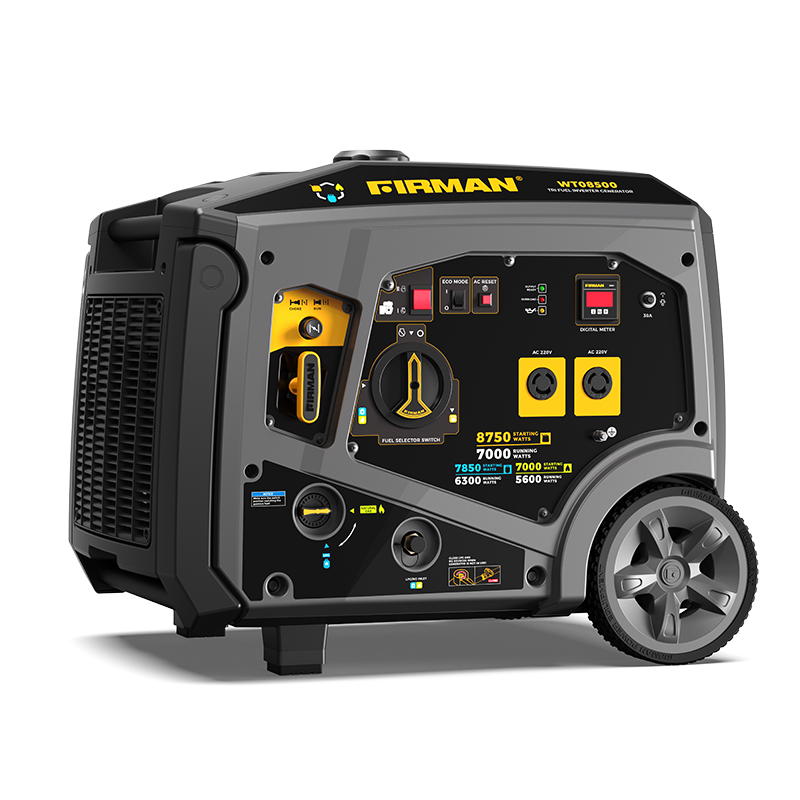
A portable generator with inverter technology can provide more flexibility when it supports multiple fuel types. The Firman WT08500 is an example of a tri-fuel inverter generator that can operate using gasoline, LPG, and natural gas. This allows users to select the most suitable fuel source based on availability and operating conditions.
For businesses working in remote areas, outdoor environments, or emergency situations, multiple fuel options can provide additional operational security. Instead of depending on a single energy source, companies can adapt their fuel choice according to the situation.
Consider Power Output and Application Requirements
Selecting generator capacity based only on maximum output can lead to unsuitable choices. Businesses should calculate both starting watts and running watts because many electrical devices require higher power during startup.
The Firman WT08500 provides different output capabilities depending on the selected fuel type. When operating on gasoline, it delivers 6.85 kW starting watts and 5.50 kW running watts, while natural gas operation provides 5.60 kW starting watts and 4.50 kW running watts. These specifications allow businesses to evaluate whether the generator can support their required equipment under different fuel conditions.
Beyond output, users should also consider power quality. For applications involving sensitive electronics or precision equipment, inverter technology can be a significant advantage because it helps maintain more stable electrical performance.
Review Runtime, Maintenance, and Operational Convenience
Runtime affects how efficiently businesses can manage their power supply. Equipment that requires frequent refueling may increase labor requirements and interrupt operations, especially during extended use.
The Firman WT08500 is designed with an extended-runtime fuel system. The manufacturer highlights its large fuel tank capacity, which helps reduce refueling frequency, and an integrated fuel gauge that allows users to monitor fuel levels more conveniently.
Maintenance is another key consideration. Portable generators generally require regular inspections, including oil checks, filter maintenance, and fuel-system care. Natural gas generators may require professional installation and scheduled servicing to maintain dependable performance over time.
Businesses should also consider whether operators can easily manage the equipment. Features such as recoil/electric start, battery support, and wheels on the WT08500 can improve usability in outdoor and mobile applications.
Choosing Reliable Power Equipment Manufacturers
The generator supplier is an important part of the purchasing decision. Experienced power equipment manufacturers typically provide stronger quality management, product testing procedures, and technical support, helping businesses reduce operational risks.
Firman emphasizes quality control throughout its manufacturing process, including SOP management, risk management systems, and multi-step inspection procedures. The company also states that new models undergo 500 hours of continuous testing before production to identify potential improvements and improve product reliability.
For business buyers, these manufacturing practices provide useful information when comparing generator suppliers. Reliable equipment depends not only on design but also on how carefully it is produced and tested before reaching the market.
Making the Right Generator Choice for Business Needs
The decision between a portable generator with inverter and a natural gas generator depends on the business environment, operating requirements, and available infrastructure. Companies requiring mobility, fuel flexibility, and stable power output may benefit from a tri-fuel inverter solution. Facilities needing permanent backup power with an accessible gas supply may find a natural gas generator more appropriate.
The Firman WT08500 demonstrates how portable inverter technology can combine multiple fuel options with practical operating features. By reviewing power requirements, fuel availability, runtime expectations, and maintenance needs, businesses can choose a generator solution that supports reliable operations in both everyday and emergency situations.
