

Facilities running multiple lanes, dock doors, or production stations often assume they need one antenna, one cable, and one reader for every single point, which multiplies budget and cabling fast.
Systems integrators and facility managers sizing up a new RFID deployment usually ask a more practical question first: can a single 4-port RFID reader cover four separate antenna positions instead of buying four standalone units? For UHF RFID deployments, the answer is yes in most cases, provided the reader, antennas, and cabling are matched to the site.
RSTC, an RFID hardware supplier working across warehousing, logistics, and manufacturing, builds fixed readers around this multi-port approach, and understanding how port allocation, output power, and antenna choice interact together will save both cost and rework during installation.
How a 4-Port UHF RFID Reader Handles Multiple Antennas
A 4-port UHF RFID reader carries a single RF transceiver inside, but the onboard controller switches, or multiplexes, between the four antenna ports in rapid succession, polling each connected antenna for tags within its read zone. Because the switching happens in milliseconds, each port behaves like an independent read point even though only one radio module is doing the work.
This differs from running four separate single-port readers, each of which needs its own power supply, network drop, and management connection. With one 4 port RFID reader, all four antenna zones report back to the same device, which simplifies wiring, reduces the number of IP addresses to manage, and centralizes firmware updates and diagnostics into a single unit instead of four.
Inside the RS-F905 4-Port UHF RFID Reader
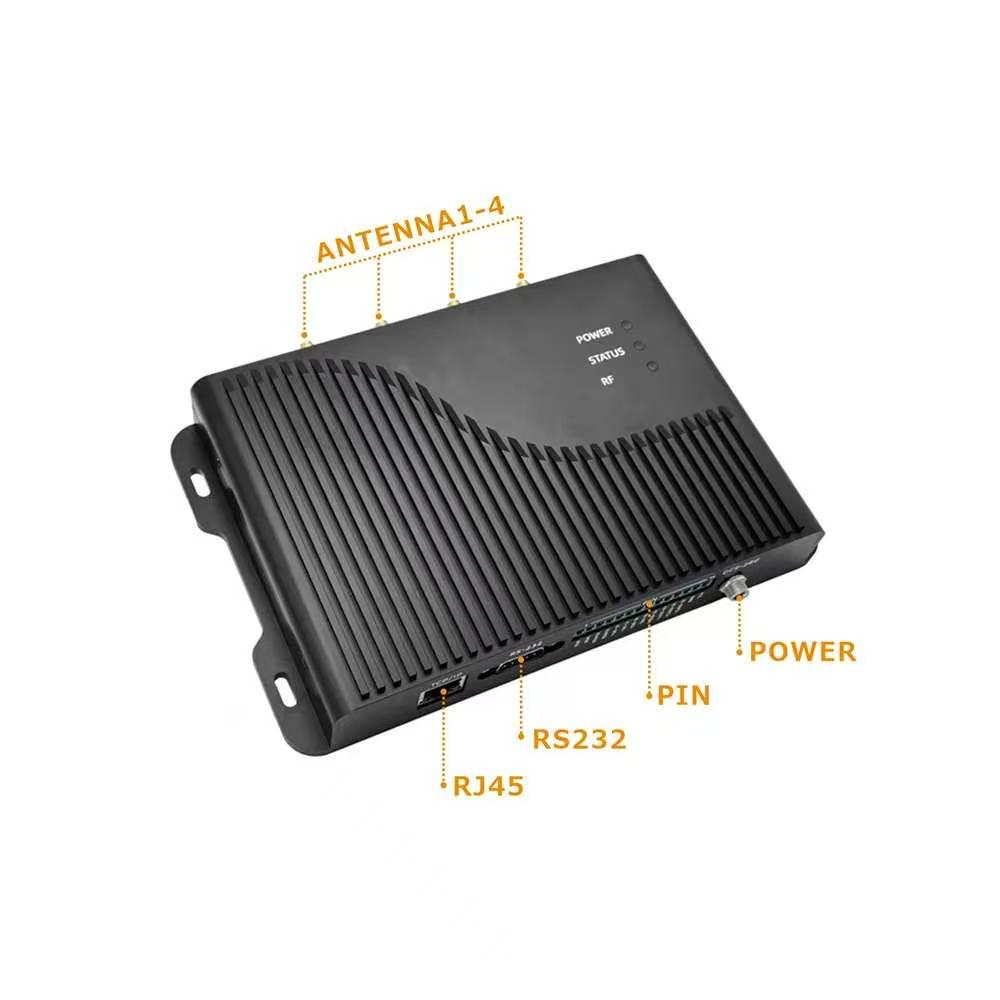
RSTC’s RS-F905 four-port UHF RFID reader illustrates what this looks like in practice. Built around the Impinj E710 chipset, it carries four dedicated SMA antenna interfaces, so operators can connect up to four separate UHF RFID antennas to cover different lanes, dock doors, or inspection points from one enclosure.
Output power is adjustable from 5dBm to 33dBm in 1dBm steps, allowing installers to adjust the effective read range for each antenna zone according to the required coverage.
Reading distance reaches up to 25 meters, though the figure at any given port depends on which antenna is attached, cable length, and tag type in use. Connectivity runs through RJ45, RS-232, or RS-485, with 4G or Wi-Fi available as optional add-ons, and two relay outputs plus two optically isolated inputs are built in for tying the reader into gates, indicator lights, or existing automation systems.
The housing carries an IP54 rating on its own, rising to IP65 when paired with a waterproof enclosure, a detail worth checking against site conditions before ordering hardware for an outdoor lane or loading dock.
On the compliance side, the unit follows EPC Class 1 Gen 2 (ISO18000-6C) protocol and covers regional UHF bands, including 902-928MHz in North America, 865-868MHz in Europe, and 920-925MHz in China, so the correct frequency plan still needs to be confirmed against local regulations before deployment.
Matching Antennas and Cabling to Each Port
Running four antennas from one 4-port UHF RFID reader works well only when each port is treated as its own RF chain rather than an afterthought. Cable length and quality matter: longer or lower-grade coax between reader and antenna introduces signal loss, which can shrink the effective read range at that particular port even though the reader’s rated output power hasn’t changed. Antenna choice also needs to match the read zone.
A circularly polarized UHF RFID antenna tolerates tags arriving at inconsistent angles, which suits warehouse entrances or conveyor lines, while a linearly polarized antenna gives more focused coverage for a single vehicle lane or a fixed inspection point. Because each port can carry a different antenna type, one reader can realistically serve four distinct zones with different coverage needs instead of forcing every zone into the same footprint.
When a 4-Port RFID Reader Makes Sense, and When It Doesn’t
The multi-port approach tends to fit situations where several read points sit within reasonable cable-run distance of one another and can share a single enclosure: a warehouse entrance with two doors, a production line with staged checkpoints, or a parking facility with entry and exit lanes covered from one control cabinet.
RSTC lists this configuration under asset tracking, warehouse and logistics management, parking and charge management, and personnel attendance, since those use cases typically involve multiple fixed points that sit reasonably close together.
When read points are spread across a large site with long distances between them, running separate readers, or choosing a reader with a longer per-port cable budget, tends to work out more practical than stretching four cable runs back to one central unit.
Planning Your Antenna Layout Before You Buy
Before settling on hardware, it helps to map out how many read points a project needs, how far apart they sit, and what kind of tag orientation each zone will see. That groundwork determines whether one 4-port RFID reader can genuinely replace four separate units, or whether a mixed setup fits the site better.
RSTC supports this kind of planning directly, offering sample testing and configuration guidance alongside its RFID reader, antenna, and tag lineup, so the hardware gets matched to the site instead of the other way around.
For teams weighing options on a multi-lane or multi-station deployment, starting with a real spec sheet and a site walk-through tends to save more time than guessing at port counts later, and it usually settles the antenna question well before installation day.
