

Power distribution is a supporting part of renewable energy projects, but its design directly affects how generated electricity reaches the grid or local loads. Solar farms, wind projects, battery systems, and hybrid plants can operate at different voltage levels. A suitable distribution system connects these sources, controls power flow, and provides protection when faults occur.
Good distribution planning matters when a project grows. Equipment must fit the site, voltage level, protection scheme, and expected load. For industrial buyers, these details affect installation, maintenance access, safety, and expansion.
Why Power Distribution Matters in Renewable Projects
Renewable generation is not always close to the point of consumption. Electricity may pass through several stages before reaching a transformer, switchboard, or grid connection. Each stage needs equipment with the correct voltage rating and protection functions.
Power distribution equipment creates controlled paths for this flow. Switchgear can isolate a faulty section, while protection devices can detect abnormal current or short circuits. This limits the affected area and makes maintenance work more manageable.
Voltage conversion is another key point. Solar and wind equipment may use power conversion systems before electricity enters a medium-voltage network. Distribution equipment must match these interfaces and provide a practical connection between generation units and downstream systems.
How Distribution Supports a Renewable Energy Solution
A renewable energy solution needs more than generation equipment. Its electrical architecture must connect generation, conversion, protection, and loads in a coordinated way. Distribution equipment provides the physical and electrical links between these sections.
Medium-voltage distribution is important in larger installations. Raising voltage can reduce current for the same power transfer, which can help limit cable losses and make longer power paths more practical. Voltage still depends on the project design, grid conditions, and equipment ratings.
Protection coordination also affects project operation. Relays, breakers, fuses, and other protective devices need suitable settings for the network. Poor coordination can cause a small fault to disconnect a wider section. Engineers therefore review fault levels and protection curves during system design.
Choosing Equipment for Outdoor and Compact Installations
Site conditions can change equipment selection. Renewable projects may be installed in open areas where equipment faces dust, rain, temperature changes, or limited maintenance access. Enclosed medium-voltage equipment can reduce exposure of live components to surrounding conditions.
Space is another practical concern. Solar substations and wind sites may have strict equipment footprint limits. Compact switchgear can simplify layout planning when clearances, cable routes, and service areas are considered together.
Installation method also matters. Modular equipment allows engineers to configure sections according to feeder numbers, connection points, and future requirements. This can reduce changes to the main arrangement when a project needs additional circuits later.
Where Medium-Voltage Ring Main Units Fit
Ring Main Units, or RMUs, are used in medium-voltage distribution networks where several feeders or transformer connections need controlled switching. Their compact format is useful when space is limited and equipment must fit into a structured distribution network.
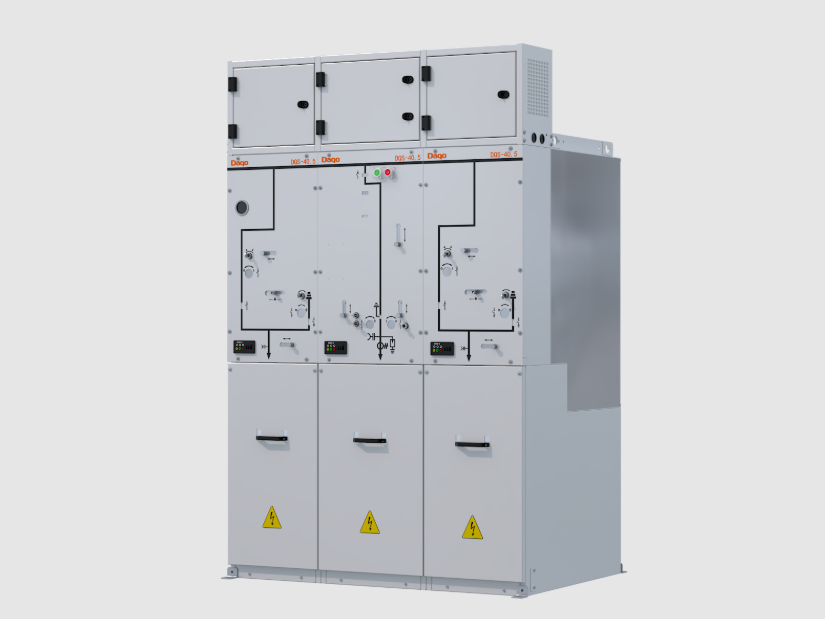
For projects requiring enclosed equipment, the DQS-40.5 Gas-Insulated Ring Main Unit uses a fully enclosed design. Its live components are housed inside a stainless steel tank. This construction provides operational safety and protects internal electrical parts from surrounding site conditions.
The DQS-40.5 is a gas-insulated RMU for medium-voltage power distribution. Its modular structure supports top and side expansion through fully insulated solid busbars. Different configurations can therefore be considered according to project requirements.
Protection and Expansion in Renewable Networks
Fault protection becomes important when multiple generation units and feeders share one distribution network. An arc fault can create severe pressure and heat inside switchgear. Equipment with a defined arc-resistance rating gives engineers a specific value to consider during selection.
The DQS-40.5 offers 25kA/1s arc resistance for outdoor operation. This provides a reference when designers review medium-voltage equipment for renewable installations. It should still be assessed alongside the site’s calculated fault current and protection design.
Expansion is also worth considering during planning. Renewable projects can add generation capacity, storage, or new feeders over time. A modular distribution arrangement can make later changes easier to plan because additional sections can be considered without redesigning the whole network.
Making Equipment Selection More Practical
Technical specifications should be checked against the actual project rather than viewed separately. Buyers can start with voltage level, rated current, short-circuit conditions, installation location, cable arrangement, and feeder quantity. These factors help narrow the suitable equipment range.
Certification is useful for projects involving international procurement. The DQS-40.5 carries ASTA, KEMA, and IECEE certifications for global use. Project teams can review destination-market certification requirements before equipment approval.
Supplier capability can also affect implementation. Daqo Group provides medium- and low-voltage intelligent distribution products and integrated technical solutions for industrial application scenarios. For B2B projects, this can be useful when equipment selection involves several connected distribution components.
Building a More Adaptable Distribution Network
Renewable generation changes how power networks are planned. Output can vary with weather, while storage systems and industrial loads can change power flow at different times. Distribution equipment therefore needs to fit the electrical design, protection scheme, and operating conditions.
For buyers, a practical renewable energy solution should be evaluated through the complete power path, from generation and conversion to medium-voltage distribution and grid connection. Compact construction, modular expansion, enclosed live parts, and defined fault-performance ratings can influence equipment selection.
Daqo Group combines distribution equipment with broader technical capabilities. Its DQS-40.5 offers a compact gas-insulated RMU format for medium-voltage applications. Reviewing these features against site conditions, fault levels, expansion plans, and certification needs can help project teams make a more informed distribution decision.
