

Solar photovoltaic systems operate with direct current from PV modules through combiner boxes, batteries, and inverters. Unlike AC circuits, DC current does not naturally pass through a zero-current point during each cycle, which makes fault interruption more demanding. For this reason, selecting suitable electrical control products for DC protection is an important part of solar PV system design.
A reliable protection scheme should account for operating voltage, current, fault conditions, installation environment, and coordination between different protection devices. Choosing a device based only on its rated current can leave important safety considerations unresolved.
Why DC Protection Requires Specific Design Considerations
A solar PV installation can continue generating DC power whenever sufficient sunlight is available. Even when part of the system is disconnected, other energized sections may still present electrical hazards. A DC fault can therefore produce sustained arcing if the protective device is not designed for DC interruption.
This is why a conventional AC circuit breaker should not automatically be substituted for a DC-rated device. The breaker must have suitable DC voltage and breaking capabilities for the actual application. For PV strings and smaller DC circuits, a DC miniature circuit breaker can provide overload and short-circuit protection while supporting modular installation.
The selection should also consider the number of poles and the circuit configuration. MAXGE’s EPB-63M-DC series, for example, is available in 1P, 2P, 3P, and 4P configurations, with rated current options from 1A to 63A and DC voltage ratings depending on the pole configuration.
Matching the Breaker to PV Operating Conditions
Voltage is one of the most important factors when selecting DC protection. The maximum system voltage should be evaluated under the PV array’s worst-case operating conditions rather than relying only on its nominal voltage.
Current selection also requires attention. The protective device should accommodate normal operating current while responding appropriately to overload and short-circuit conditions. Temperature, installation method, conductor size, and ambient conditions can affect the actual current-carrying capability of the circuit.
For applications requiring an MCB for dc supply, engineers should therefore verify the breaker’s rated voltage, current, breaking capacity, pole configuration, and applicable standards before installation. MAXGE’s EPB-63M-DC documentation specifies IEC/EN 60947-2 compliance, a 6 kA breaking capacity, thermal-magnetic protection, and DIN-rail installation.
When a DC MCCB Is More Appropriate
Not every PV circuit has the same protection requirements. Larger current levels and higher-capacity DC circuits may require a molded case circuit breaker rather than a miniature breaker.
A DC MCCB is generally suited to medium and larger DC circuits where higher fault-current interruption capability and more substantial circuit protection are required. In solar PV and energy storage applications, these devices can be used to protect equipment such as inverters, cabinets, and larger DC distribution circuits.
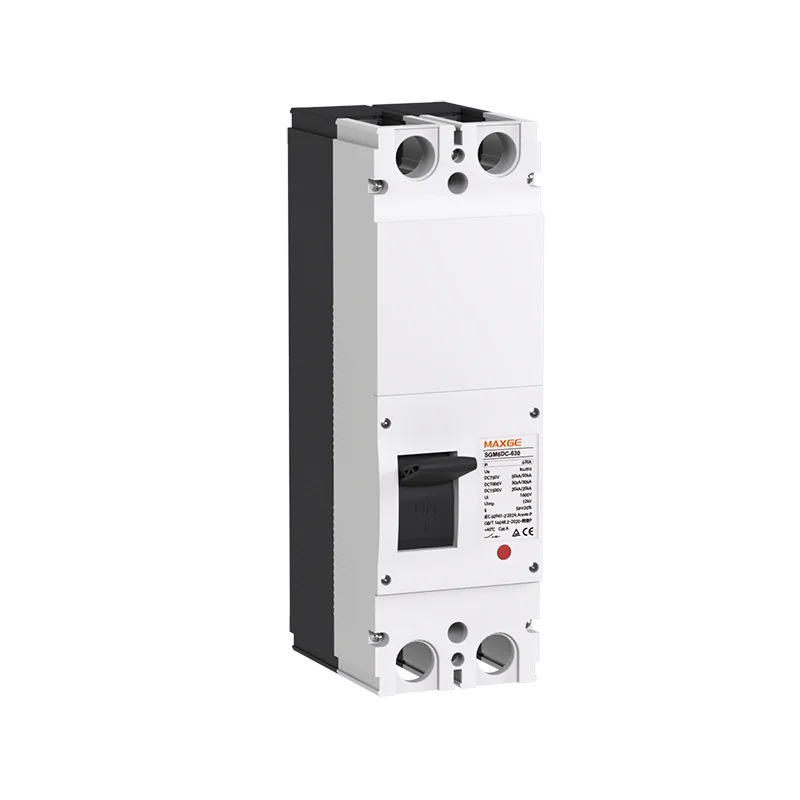
MAXGE provides the SGM6-630DC within its DC MCCB range. The product category describes DC MCCBs as protection for medium-large DC circuits, including overload and short-circuit protection for PV and energy storage applications.
The key point is that breaker selection should follow the electrical architecture of the system. Using an oversized device may reduce protection sensitivity, while an undersized device can cause unnecessary tripping during normal operation.
Combining Different DC Protection Devices
Circuit breakers are only one part of a comprehensive PV protection strategy. Depending on the system design, additional DC protection devices may be required to address different types of electrical risks.
DC surge protective devices can help manage transient overvoltage caused by lightning or switching events. DC fuses can provide overcurrent protection in applications where their characteristics are appropriate. MAXGE groups DC MCBs, DC SPD and fuse products, DC MCCBs, and DC isolators within its New Energy Device portfolio.
Protection devices should be coordinated rather than selected independently. Their ratings and characteristics need to correspond with the PV array, wiring, combiner box, inverter, battery system, and other downstream equipment. Proper coordination can help limit fault propagation while maintaining system availability where practical.
Installation and Maintenance Should Not Be Overlooked
Even a correctly selected breaker can perform poorly if installation conditions are unsuitable. Electrical connections should be properly tightened, conductors correctly sized, and devices installed according to their technical documentation. The enclosure and surrounding environment should also be considered, particularly for outdoor PV installations exposed to temperature changes, moisture, and dust.
Maintenance is equally important. Periodic inspection can identify loose terminals, signs of overheating, mechanical damage, or abnormal operation before these issues develop into more serious faults. Clear circuit identification also makes isolation and maintenance procedures more efficient.
Choosing Electrical Control Products for Solar Applications
Selecting electrical control products for solar PV systems requires more than comparing product prices or nominal current ratings. System voltage, current, fault levels, DC interruption capability, installation conditions, applicable standards, and coordination all influence the suitability of a protection solution. Different sections of a PV system, from string circuits and DC distribution to higher-current DC paths, may also require different approaches to overcurrent protection, surge protection, switching, and isolation.
MAXGE develops low-voltage electrical solutions for new energy applications, with protection solutions designed for different requirements across PV and other DC systems. Depending on the system configuration, protection may involve DC overcurrent protection for PV circuits, surge protection against transient overvoltage, and switching or isolation for maintenance and fault conditions. MAXGE’s R&D team, patented technologies, software copyrights, and testing resources including CNAS-related laboratory capabilities and international certifications support the development of electrical protection solutions for these applications.
MAXGE also operates smart manufacturing and automated production at its Deqing and Wuhu manufacturing bases, with more than 90% automation in its production operations. This manufacturing capability, combined with its broader low-voltage electrical product range, supports protection requirements across different PV system configurations.
When you need to confirm product parameters, application suitability, or available protection solutions, you can contact MAXGE through its official website. Reviewing the electrical characteristics and protection requirements from the beginning can make product selection more precise and support a more suitable PV protection strategy.
