

Selecting insulation materials for apparel, footwear, outdoor equipment, automotive components, or other lightweight products requires more than comparing thermal conductivity. Engineers and product developers must also consider flexibility, handling, moisture management, durability, processing, and everyday maintenance. Aerogel is widely recognized for its exceptional thermal insulation properties, but its inherent brittleness can create challenges in applications requiring flexibility. Y-Warm offers a different material approach, combining ultra-thin insulation with flexibility, moisture permeability, and quick drying. For manufacturers seeking an aerogel alternative, the comparison is therefore less about replacing one material universally and more about matching material characteristics to the application.
Aerogel and Y-Warm Take Different Approaches to Insulation
Aerogel is a highly porous material known for extremely low thermal conductivity. However, its porous structure can also contribute to poor mechanical properties, particularly brittleness. This limitation has historically restricted its direct use in flexible products and encouraged the development of aerogel powders, composites, coatings, and other modified forms.
Y-Warm approaches the same insulation challenge from a different direction. After years of research and development, its technology uses a nano-closed-cell flexible synthetic insulation structure supported by N₂. Instead of relying on a rigid nanoporous material, Y-Warm was developed to maintain low thermal conductivity while providing a flexible material format suitable for practical product construction.
This distinction matters for business product developers. A material can demonstrate excellent laboratory insulation performance yet become difficult to integrate when the finished product must bend, fold, sew, laminate, or withstand repeated handling.
Flexibility Makes Y-Warm Practical for Flexible Products
Flexibility is one of the clearest differences between traditional aerogel materials and Y-Warm. Monolithic silica aerogel is typically brittle, while reinforced aerogel blankets and composites can provide flexible formats for practical applications. It has limited stretch in both warp and weft directions, while bias cutting can provide additional stretch when product construction requires it.
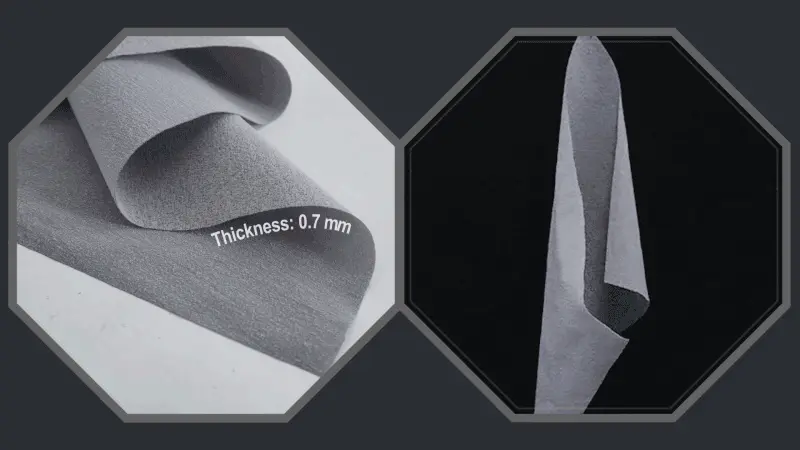
For apparel manufacturers, this characteristic can simplify product development. Y-Warm can be incorporated as an insulation layer between fabric and lining, including lightweight jackets, winter clothing, and workwear. The material is only around 0.7 mm thick in the YW-01 application and is designed to provide substantial insulation without relying on conventional bulk.
The same principle can benefit footwear, gloves, insulated bags, tents, bedding, and other products where the insulation layer must conform to the product rather than behave like a rigid component. Y-Warm’s product portfolio also includes variants developed for different requirements, including softness, higher insulation performance, and greater warp and weft strength.
Clean Handling and Moisture Management for Everyday Use
Thermal insulation is only one part of the performance equation for products worn or handled regularly. Moisture accumulation can affect comfort, drying time, and the usability of insulated products.
Y-Warm incorporates hydrophilic functional groups that allow the material to absorb moisture vapor and facilitate its movement outward. According to the manufacturer’s published information, its moisture absorption capacity is nearly twice that of the reference sample used in testing, while its evaporation rate is approximately twice that of the standard reference material.
This combination of insulation, moisture permeability, and quick drying gives Y-Warm a practical advantage for applications involving active users or repeated daily use. Outdoor apparel, footwear, gloves, tents, and bedding can benefit from insulation that does not simply block heat transfer but also supports moisture management.
Maintenance is another practical consideration. Y-Warm can be cold-water washed, machine washed, and dried at low temperatures, making it compatible with everyday care requirements when incorporated appropriately into finished products.
Lightweight Construction Supports Product Development
Weight and thickness increasingly influence product design, particularly in outdoor equipment, transportation, and performance apparel. Y-Warm is designed as an ultra-light, ultra-thin insulation material. The company’s technical information describes a 0.7 mm material thickness for its lightweight insulation application, while its published supply format is 150 cm wide with 50-meter rolls.
For manufacturers, this format can create opportunities to reduce bulk while preserving thermal protection. A thinner insulation layer can support more streamlined garments and portable products, while the roll format is suited to material processing and integration into larger production workflows.
Y-Warm is also being positioned beyond apparel. Its documented applications include outdoor gear, tents, automotive insulation, construction, railway insulation, aviation, curtains, and comforters. This broader application range demonstrates why a flexible aerogel alternative can be relevant wherever thermal insulation must coexist with mechanical adaptability and lightweight construction.
Choosing the Right Material for the Application
Aerogel remains relevant when extremely high-performance insulation is required and the application can accommodate its mechanical limitations or use it in a modified form. Y-Warm becomes particularly relevant when flexibility, thinness, moisture permeability, quick drying, and everyday handling are equally important.
For product developers evaluating an aerogel alternative, the key question should therefore be practical: Does the insulation material need to remain flexible, lightweight, washable, and easy to integrate into textile-based or other flexible products? If so, Y-Warm provides a material architecture specifically designed around those requirements.
A New Direction for Flexible Thermal Insulation
Y-Warm Technologies Co., Ltd. specializes in the research, development, and industrialization of metamaterials, with Y-Warm™ positioned as a flexible thermal insulation material for apparel, outdoor gear, automotive, construction, and other applications. Its development program has focused on combining low thermal conductivity with flexibility, moisture permeability, and quick drying.
For manufacturers and product developers exploring an aerogel alternative, Y-Warm offers an opportunity to evaluate a different balance between thermal performance and practical usability. Contact Y-Warm to request technical information or samples and assess whether its flexible insulation technology fits the requirements of your next product.
